Units of measure
Every product has one unit of measure (O'lchov birligi). Stock, sale price and cost are kept in that unit: if the unit is kg, the price is per 1 kg and stock is in kilograms.
Which unit to pick
Section titled “Which unit to pick”| What you sell | Unit | What happens at the till |
|---|---|---|
| Drinks, soap, a shirt, a socket | dona (piece) | One tap puts 1 piece in the basket |
| Rice, sugar, nails, fruit | kg | The quantity sheet opens: type 1.5 kg |
| Cable, hose, fabric, chain | metr (metre) | Type 12.5 metres |
| Sunflower oil, antifreeze (poured) | litr (litre) | Type 2 litres |
| Perfume poured into vials (decants, "razliv") | ml | Type 10 ml |
| Oil perfume, spices (weighed) | gramm (gram) | Type 5 grams |
The list also has quti (box), pachka (pack) and blok units. Pick them only if the product is never opened and always sold as a whole box. If you sell both the box and single pieces, use dona and add the box under Boxes and packs.
Whole numbers and decimals
Section titled “Whole numbers and decimals”- A Dona (piece) type unit (dona, quti, pachka, blok) sells in whole numbers only: 1, 2, 3. The till does not accept
1.5pieces. - Og'irlik, hajm, uzunlik (weight, volume, length: kg, gramm, litr, ml, metr) take up to 3 decimals:
0.250kg = 250 grams,1.005metres = 1 metre 5 mm.
The amount is always rounded to a whole so'm. The rule: price of 1 kg × weight = amount. Rice costs 14 000 so'm per kg and the customer takes 2.5 kg: 14 000 × 2.5 = 35 000 so'm.
How it sells at the till
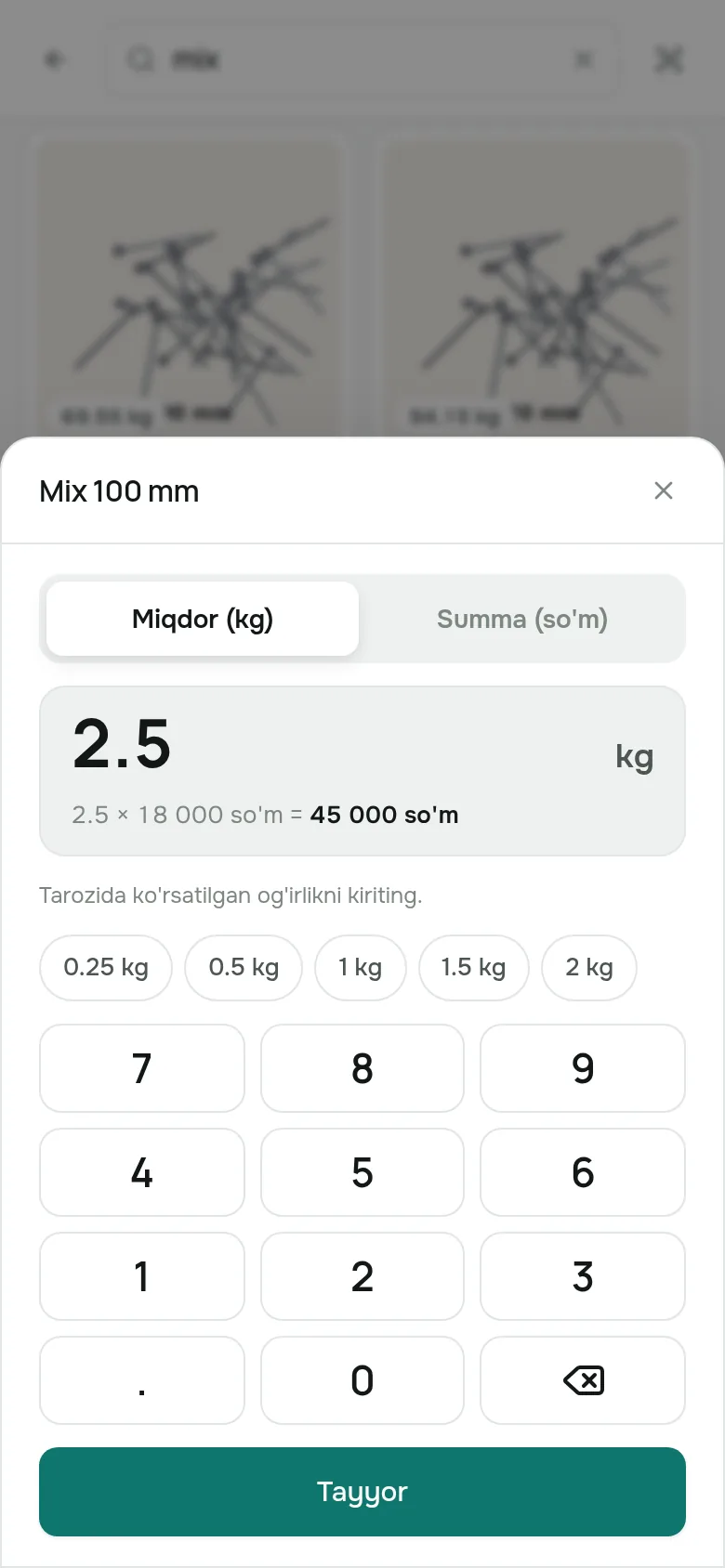
Section titled “How it sells at the till”Tapping a dona product adds 1 piece to the basket. Tapping or scanning a product in any other unit opens the quantity sheet (except a label printed by a scale: it carries the weight, so the product goes straight into the basket):
-
Type the quantity or tap a quick amount:
- kg: 0.25, 0.5, 1, 1.5, 2;
- gramm and ml: 3, 5, 10, 20, 50, 100;
- litr and metr: no quick amounts, you type the number.
-
Underneath you see the sum, such as
1.5 × 14 000 so'm = 21 000 so'm. -
Tap Tayyor (Done): the product goes into the basket.
Selling by the amount of money
Section titled “Selling by the amount of money”When a customer says "give me 10 000 so'm worth", choose Summa (so'm) (Amount, so'm) in the quantity sheet and type 10 000 (or tap one of 5 000, 10 000, 20 000, 50 000). The app shows how much to weigh out: Torting: 0.715 kg (Weigh out), when rice costs 14 000 so'm per kg. The quantity is rounded up (to the gram for kg), so the customer never gets less, and the line comes to exactly 10 000 so'm: the few so'm the rounding adds are recorded as a discount.
This works for every unit except the piece-type ones (dona, quti, pachka, blok): kg, gramm, litr, ml, metr.
Adding your own unit
Section titled “Adding your own unit”If the unit you need is not in the list (for example juft (pair), rulon (roll), m²), the owner or manager adds it.
-
Sozlamalar (Settings) → O'lchov birliklari (Units of measure) → Qo'shish (Add).
-
Kod (Code): a short Latin code such as
juft. Nomi (o'zbekcha) and Nomi (ruscha) (Uzbek and Russian names). -
Turi (Type): Dona (whole numbers only), Og'irlik, Hajm or Uzunlik (up to 3 decimals). If m² sells with decimals, set its type to Uzunlik (length).
-
Saqlash (Save). The unit can now be picked on a product.
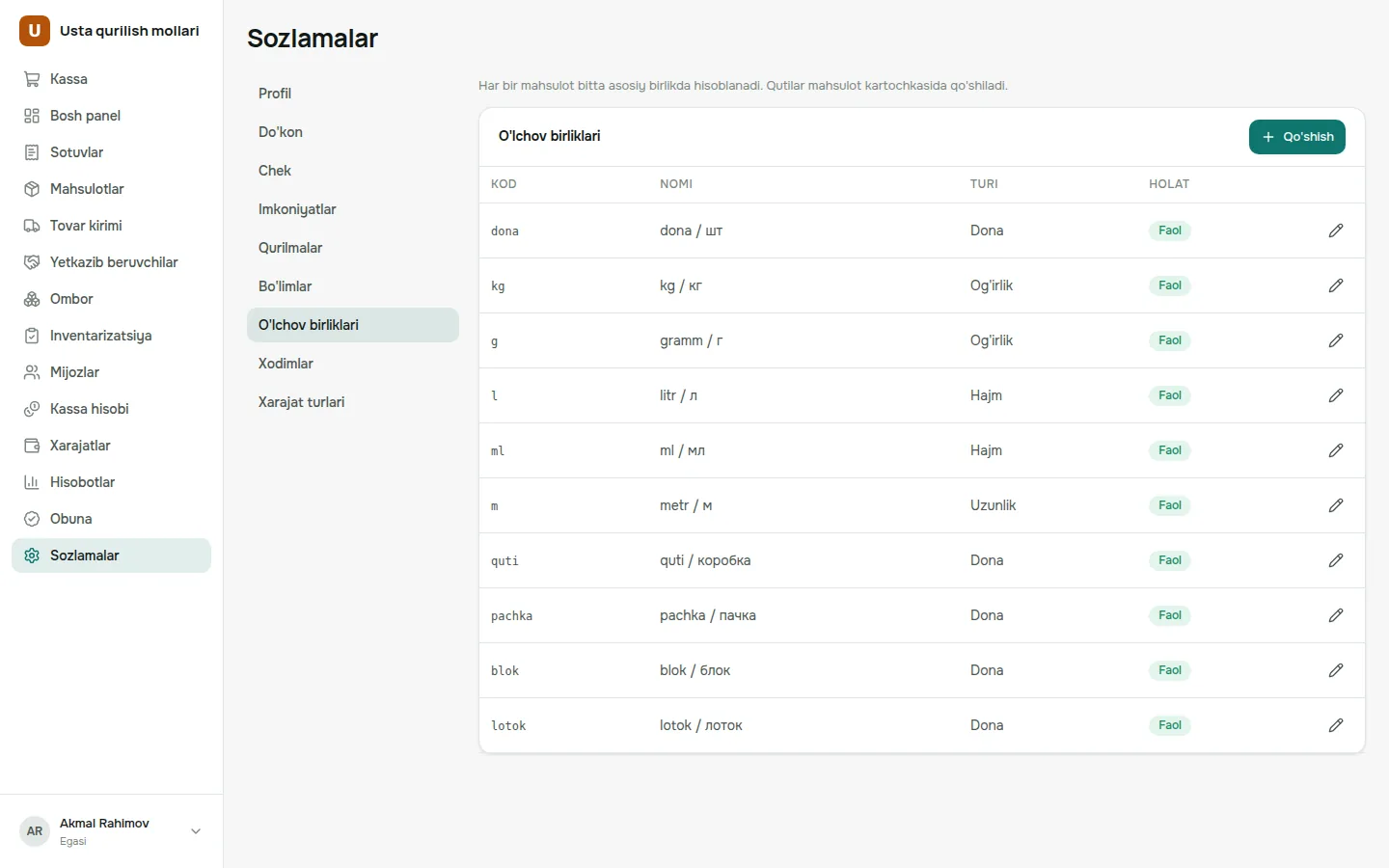
A unit cannot be deleted. If you no longer need it, edit it and switch Faol (Active) off: it can no longer be picked on a product page.
I picked the wrong unit
Section titled “I picked the wrong unit”If the product has no movements yet (no stock entered, nothing sold or received), change the unit and tap Saqlash. Done.
If it has movements, the app does not change the unit. This is on purpose: 50 pieces must not suddenly become 50 kg, and old sales and reports must stay right. Create a new product instead:
-
Open the old product and look at its stock at the top of the page (for example Qoldiq: 50 dona). Work out how much there really is, for example 12.5 kg.
-
Tap Arxivga (Archive) on the old product. It leaves the till; its sales history stays.
-
Add a Yangi mahsulot (New product): the same name, the right unit, the price. Type the old barcode too: the archived product gives the code up by itself.
-
Type the real stock in Hozirgi qoldiq (Current stock), 12.5, and save.
Archiving is done by the owner or the manager.
Questions
Section titled “Questions”Can a piece product be sold as a half? No, dona is whole numbers only. If an item is sold in parts, keep it in a decimal unit such as kg or metr.
Nails are sold by kg, but they also come in a box.
Unit kg, and add the box under Quti va pachkalar as Quti, holding 25 kg. Tapping the box takes 25 kg. See Box and piece.
What if I sell 50 cm of cable?
Unit metr; type 0.5 at the till.
Can a weighed product use grams? If you sell it with the barcode the scale prints, the unit must be kg. See Scales.